Saturday, October 13, 2012

Module 6-Duck For President/Pink and Say (w/book trailer)


Module 6-Picture Books

Picture Books for Younger Readers


Duck For President by Doreen Cronin
ISBN:  978-0-6898-6377-6

Audience (according to School Library Journal):  PreSchool-grade 2

Cronin, D.  (2004).  Duck for president.  New York, NY: 
     Scholastic, Inc.
     
Pricing (as of 10/12)
*Amazon:      Hardcover: $12.23
                        Kindle:  $12.99

Book Summary
            Tired of being bossed around by a stinky farmer, Duck decides to oust Farmer Brown by getting himself put in charge through an election among the farm animals.  Duck wins by a landslide but decides that running a far isn’t much fun and that becoming governor would be better.  He and his staff of ducks campaign and soon, Duck is elected governor by the smallest of margins.  His new job gives him a headache so Duck and his staff begin campaigning for president.  Winning that election as well, Duck discovers that his headache is worse and decides to return to the farm…and write his autobiography.

APA Reference
Cronin, D.  (2004).  Duck for president.  New York, NY:  Scholastic, Inc.

Impressions
            While this very entertaining book with its terrific illustrations by Caldecott honoree Betsy Lewin will be enjoyed by young children and will make them laugh at the idea of a duck being president, this book is primarily for politically savvy adults.  The veiled (and not so veiled) allusions to previous presidential campaigns and political issues abound and every U.S. history fan and/or teacher should own a copy.  The satire is outstanding and is cleverly couched in a book that young children will absolutely love reading right alongside their parent(s).  This is truly a book with universal appeal as kindergarten students will get a chuckle out of the absurdity, middle elementary school aged children will gain some insight into the election process, and adults on both sides of the political fence will also be amused.

Professional Reviews
            << This award-winning team returns with a third story of farm animals with ambition. Duck is tired of doing his chores (mowing the lawn and grinding the coffee beans), and decides to hold an election to replace Farmer Brown… Lewin's characteristic humorous watercolors with bold black outlines fill the pages with color and jokes. Cronin's text is hilarious for kids and adults and includes a little math and quite a bit about the electoral process. The animals, who have no verbal language that humans can understand, are empowered by the use of the written word, and the subliminal message comes through loud and clear-one can almost hear youngsters thinking, "Watch out grown-ups! Just wait till I learn to read."

Barrer, J., Jones, T. E., Toth, L., Charnizon, M., Grabarek, D., & Larkins, J. (2004). Duck for president (book). School Library Journal, 50(3), 155-156. Retrieved from http://www.slj.com.

                 <<…Though Cronin's latest Duck tale introduces the basic mechanics of the election process, it lacks many of the silly high jinks and clever plot turns that gave its predecessors their charm. A few nods to past presidents appear in both text and art (Nixon, Clinton, G.H.W. Bush), offering older readers a knowing wink. The focus on Duck's dissatisfaction and loneliness at the top makes the story line perhaps better suited to adults, even as Lewin's chunky-outlined watercolors continue to cater to the younger crowd with her usual dashes of humor and daffy sweetness. Her depictions of the campaign-trail motorcades, parades and town meetings are a hoot.

Duck for president (book). (2004). Publishers Weekly, 251(7), 170-170. Retrieved from http://www.publishersweekly.com.

Library Uses
During the election season, this book (and others like it) should absolutely be on display, put into a bibliography of available election themed fiction/non-fiction titles for use by Social Studies/History teachers from elementary through high school levels, and/or be used as a read aloud or book talk title during library time in the elementary school.


Picture Books for Older Readers


Pink and Say by Patricia Polacco
ISBN:  978-0-3992-2671-7

Audience (according to Book Links): Grades 4-11

Polacco, P. (1994).  Pink and Say. New York, NY: Philomel Books.

Pricing (as of 10/12):
*Amazon:      Hardcover:  $11.24
                        Paperback:  $6.79
                        Audible Audio Edition:  $4.95


Book Summary
         Polacco gives honor to an ancestor in this Civil War based picture book.  Sheldon Russell Curtis told his story to his daughter who told her son who told his daughter who wrote it down in “Sheldon’s own words as nearly as [she could].”  Wounded in battle, Yankee soldier and teenager Sheldon “Say” Curtis lay dying in a field.  A young soldier from the 48th Colored Company carries him home to his mother’s house and there, the two of them nurse Say back to health. Pinkus “Pink” Aylee and Say share their experiences and become fast friends as they both recover while under the nurturing eye of Moe Moe Bay.  Just when the two decide that they must go back to their respective companies, marauders are spotted and Pink and Say are forced by Moe Moe into the safety of the root cellar.  Thinking that even raiders won’t harm an old, black woman, Moe Moe stays in the house to draw them off and give her son and his friend a chance to rejoin their units.  When Pink and Say come out of hiding, they find Moe Moe dead and must bury her before starting their journey.  Things for the pair go from bad to worse and the two are captured by the Confederate army and sent to Andersonville prison camp where they are forcibly separated.  After being returned home after the war, Sheldon Curtis is told that his friend and rescuer was hanged shortly after he arrived at Andersonville and his body thrown into a lime pit.

APA Reference
Polacco, P. (1994).  Pink and Say. New York, NY: Philomel Books.

Impressions
         Book Links rates this book as being appropriate for grades 4-11 but I believe that age range should be extended to adulthood.  Author Patricia Polacco does of superb job of telling a story of friendship that will touch the hearts of all ages.  The youngest readers/listeners may not grasp the level of sacrifice and risk that Pink and his mother made when they befriend and save a white boy during that turbulent time, but older readers will.  All will see the theme of friendship and some will see that element of selflessness and sacrifice.  The dialogue is authentic without using such heavy dialect that younger readers will struggle to comprehend it.  The artwork, acrylic with pen and ink, enhances the story and reinforces the time period flawlessly.   This book, like Duck for President, demonstrate that a picture book can truly have universal appeal and is another “must have” for Social Studies/History teachers.

Professional Reviews
            << Polacco relates a true incident from her family’s history in this powerful story set during the Civil War.  Fifteen-year-old Sheldon “Say” Curtis ahs been wounded and left for dead by his fellow white Union soldiers.  Pinkus “Pink” Aylee, a 15-year-old African American Union soldier, fins Say and carries him home to his mother, Moe Moe Bay…..This picture book is a departure for Polacco in terms of content and audience, but the familial ties still remain.

Pink and say. (2005). Book Links, 15(1), 55-55. Retrieved from http://www.booklistonline/booklinks.
            << This book, the story of Polacco's great-great-grandfather, has been passed down from generation to generation in the author-artist's family… Told in Say's colorful, country-fresh voice, the text incorporates authentic-sounding dialect and expressions - such as darky - that would have been used at the time. Polacco's characteristic acrylic, ink, and pencil illustrations are suitably dramatic and focus on the intense physical and emotional joy and pain of the story's three main characters. The remarkable story, made even more extraordinary in its basis in actual events, raises questions about courage, war, family, and slavery. A not-to-be-missed tour de force.

Fader, E., & Silvey, A. (1994). Pink and say. Horn Book Magazine, 70(6), 724-725. Retrieved from http://www.hbook.com.

Library Uses
Excellent example of a work that crosses over genre lines—biographical, picture book, non-fiction civil war title.  A librarian could use this title to demonstrate how different key word searches would all result in this title as well as show how one book could possibly be shelved in several different areas in a library.

Book Trailer


Saturday, October 6, 2012

Module 5-How I Live Now/Ship Breaker


Module 5-Other Award Winners

Michael Printz Award Winners:

How I Live Now by Meg Rosoff
ISBN:  978-0-3859-0908-0

Audience (according to School Library Journal): grade 8 and up

Rosoff, M. (2004). How I live now.  New York, NY: Wendy 
     Lamb Books.

Pricing (as of 10/12):
            Amazon:        Hardcover:  $10.00
                                    Paperback:  $7.99
                                    Audio CD:     $38.00
                                    Audible Audio Edition:  $16.95

Book Summary
         Anorexic and unhappy, Daisy leaves New York, her father, and her pregnant stepmother who she has dubbed Davina the Diabolical.  She lands in England and meets her four cousins, Isaac, Osbert, Edmond, and Piper, and hears about her aunt who is away dealing with political rumblings.  Daisy forms an immediate attachment to sweet Piper and is drawn to the mysterious Edmond.  This initial curiosity turns to a secret passion and a feeling of love that Daisy so desperately craves.  Within days of her arrival, however, war with an unnamed foe breaks out and the English countryside becomes a battle zone.  The cousins are eventually separated and the family farmhouse confiscated. Piper and Daisy are sent to one location and the boys to another.  As Piper and Daisy struggle to escape from their temporary home, a bond develops between them that brings out a warmth and nurturing in Daisy that is unexpected.  The girls manage to find their way back home, finding it empty and ravaged.  As the war ends and before the cousins are reunited, her father abruptly whisks Daisy back to New York.  Her unhappiness in the states apparent, she is allowed to return to England and finds that the Edmond she fell in love with has been left traumatized by his experiences. Ultimately, her heart assures her that this is the place that she will now call home and that she will be patient and wait for Edmond to heal and reciprocate her feelings once again.


APA Reference
Rosoff, M. (2004). How I live now.  New York, NY: Wendy Lamb Books.

Impressions
            Rosoff creates a delightfully different dystopian book by using the first person voice of Daisy throughout.  Daisy's tone, vocabulary, and voice are unique and her pain and growth throughout her wartime experiences are profound.  Rosoff focuses more on these changes than on the unnamed enemy or the death and destruction that war typically brings.  The realities of the war are present, but are not an overwhelming element of this riveting YA book.  For those who are concerned with the fact that the 15-year-old heroine begins a sexual relationship with her first cousin, the details of their affair are scant.  The language of the characters is moving and emotions are strong without resorting to ubiquitous profanity.  Readers will love warm, sweet Piper, hurt for Daisy and hope that she finds a haven for her damaged heart, and will likely forget that the love between Daisy and Edmond is viewed by most of society as wrong.

Professional Reviews
            << Impending war, parental rejection, and anorexia are Daisy's concerns as she steps off the plane in England where she's been sent to stay with her Aunt Pen and her four cousins. The 15-year-old has landed in a chaotic but supportive country household where she is immediately intrigued by her cousin, Edmund. In this novel (Wendy Lamb Books, 2004), Meg Rosoff explores what happens when war leaves these five youngsters to fend for themselves….Though the novel has disturbing elements, Rosoff handles the harshness of war and the taboo of incest with honest introspection. This Printz award winner is a good choice for book discussions as it considers the disruption of war both physically and emotionally and should be on every high school and public library shelf.

Wysocki, B., & Mandell, P. L. (2005). How I live now. School Library Journal,
     51(8), 68-68. Retrieved from http://slj.com.

            << This first novel is intelligent, funny, serious, and sweet; a winning combination of acerbic commentary, innocence, and sober vision…. Refreshingly, Rosoff understates Daisy's transformation from self-absorbed, defensive anorexic to generous, loving hero, but that inner evolution is always apparent in her bracing wit and intense response to beauty, both human and natural. Hilarious, lyrical, and compassionate, this is, literarily and emotionally, deeply satisfying.

Baker, D. F. (2004). How I live now (book). Horn Book Magazine, 80(5), 597-580. Retrieved from http://www.book.com.
Library Uses
  1.   .   This book would be an excellent choice to include in a display or book talk on award winning YA literature.  It has a unique voice and should appeal to both male and female high school students.  The display should include a summary with each book and the one for How I Live Now should focus on the war and forbidden aspects in order to capture the attention of the reluctant reader.
  2.   .   As writing is emphasized in all classes with the new emphasis on short answer and compositions in the EOC exams, the librarian should provide examples of varying points of view to encourage students to try more creative uses of voice in their writing.  How I Live Now would be a title to promote with ELA teachers especially, but this title would find a niche in the History class as well.


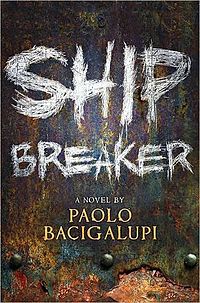
Ship Breaker by Paolo Bacigalupi
ISBN:  978-0-316-05621-2

Audience (according to School Library Journal):  grade 7 and up

Bacigalupi, P. (2010). Ship breaker. New York, NY: Little, 
     Brown and Company.

Pricing (as of 10/12)
Amazon:        Hardcover:  $11.38
                        Paperback:  $9.99
                        Audio CD:     $11.59
                        Audible Audio Edition:  $21.95  

Book Summary
            Set on America’s Gulf Coast sometime in the future, teenaged Nailer works on a light crew, stripping grounded oil tankers of anything of value.  His crew scavenges in order to make quota or face the consequences from a merciless company.  Crewmembers swear to stick by on another no matter what, but the hope of someday making a Lucky Strike pushes some to turn their backs on solemn oaths.  Nailer’s life is further complicated by the death of his mother, an abusive and alcoholic father, and the trials of a poverty stricken society.  Finding a ship wrecked clipper ship, Nailer and his friend and light crew partner, Pima, face a difficult decision:  find a way to strip the ship and claim their own “Lucky Strike” or save the unfortunate survivor, a beautiful heiress.  The book takes readers through swamps and cities nearly underwater and leaves them on the edge of their seat as Nailer tries to evade his angry father, make a future for himself, and do the right thing.

APA Reference
Bacigalupi, P. (2010). Ship breaker. New York, NY: Little, Brown and Company.

Impressions
            Paolo Bacigalupi does a magnificent job of writing a book that will appeal to young adults who crave “on the edge” material without actually crossing the line into poor taste.  The futuristic world of light crew is rough and full of those who will do or say anything in order to survive and while the language of the characters is realistic to this time period, it is not overly crass.  The character of Nailer is conflicted throughout the book—needs to survive, to fit in with his crew, to be accepted by his father, to leave the poverty of his life, and yet to honor his conscience all join together to make the reader cheer when something go right for the young hero and sigh when life hands him another lemon.  In this book, Bacigalupi also demonstrates great skill in keeping the reader guessing. Twists and turns and unexpected events abound In this award-winning book.

Professional Reviews
            << …Exciting and sometimes violent, this book will appeal to older fans of Scott Westerfeld's "Uglies" series (S & S) and similar action-oriented science fiction.

Bass, H. (2010). Ship breaker. School Library Journal, 56(6), 94-94. Retrieved from              http://slj.com.

            << This YA debut by Bacigalupi, a rising star in adult science fiction, presents a dystopian future like so many YA sf novels. What is uncommon, though, is that although Bacigalupi’s future earth is brilliantly imagined and its genesis anchored in contemporary issues, it is secondary to the memorable characters…Clearly respecting his audience, threading the backstory into the pulsing action.  The characters are layered and complex, and their almost unthinkable actions and choices seem totally credible.  Vivid, brutal, and thematically rich, this captivating title is sure to win teen fans for the award-winning Bacigalupi.

Rutan, L. (2010). Ship breaker. Booklist, 106(18), 50. Retrieved from http://www.booklist.com.
Library Uses
1.    Coupled with How I Live Now, The Maze Runner, Uglies, and The Hunger Games, a great book talk could be created to stimulate interest in dystopian fiction.  Book trailers are available for all via YouTube or TeacherTube.
2.    Genre lessons-The above titles and many more would be listed on signage in the library promoting and identifying the genre of futuristic or dystopian literature.  For libraries that use the bookstore method of classifying and shelving books, signage such as this is a must.

Friday, September 21, 2012

Module 4-Maniac Magee/Bridge to Terabithia


Module 4-Newbery Award Winners


Maniac Magee
ISBN:  978-0-3168-0906-1

Audience (according to School Library Journal): Gr. 6-10

Spinelli, J. (1990). Maniac Magee.  New York, NY:  Little,   
     Brown and Company.

Pricing (as of 9/12):
*Amazon:      Paperback:    $7.99
                        Hardcover:     $11.56
                        Audio CD:     $38.00

Book Summary
            After being orphaned, Jeffrey Lionel Magee, aka “Maniac Magee” runs away from a loveless house with an aunt and uncle in search of a place to call home.  He lands in Two Mills, a town sharply divided along black/white racial lines. Truly colorblind, Maniac does not understand when he is forced by the community to leave a possible home with the Beales just because he is white and they are not.  Briefly, he finds a place of love and acceptance with Grayson, an older, washed up, former minor league ball player, but must search again when Grayson dies.  As he hunts for a place to call his own, tales of his experiences grow into legend and he begins to meet and influence unique characters from both sides of Hector Street—Mars Bar Thompson, the Cobras, Big John McNab, Piper and Russell, to name a few.  In the end, young Jeffrey finds that home he yearns for and, hopefully, makes the town of Two Mills a better place.

APA Reference
Spinelli, J. (1990). Maniac Magee.  New York, NY:  Little,  Brown and Company.

Impressions
            This reviewer is just going to forget about pretty words and just say--I absolutely love this book!!  The characters are vivid and real—Amanda is sweet and is the sister that anyone would love to have; Mars Bar is full of that cocky attitude that is seen in all skin colors in every town; the gang of Cobras is gritty and so over the top prejudiced that readers are appalled; Piper and Russell are endearing and even young readers will feel sadness that they are turning into their big brother John and don’t seem to care that they may turn out with little to show for their lives.  But while the tone of the book has he potential to be completely negative and preachy, Spinelli weaves in strands of funny adventures, warm moments in the bathtub or reading a book, and hope that things can be different.  The story never drags and, in the end, the book can be closed with a satisfied sigh and a smile.
Professional Reviews

<<…His characters are also capable of gestures of great generosity and courage. I believe that Maniac Magee is the best-realized of this quintessential Jerry Spinelli character. He is a boy who doesn't yet know where he belongs in the great scheme of things. He runs from the darkness of his troubles, but he runs toward the light he sees shining forth from the decent people he encounters on his picaresque journey. Children, I am willing to wager, will understand at once what Maniac Magee is all about and accept him immediately as one of their own. They'll put him in that pantheon of beloved characters who become sacred points of reference when, years later, they talk about the books that meant something to them as they took that difficult, wonderful, and exciting trip through Childhood.


Keller, J. (1991). Jerry Spinelli. Horn Book Magazine, 67(4), 433-436. Retrieved from http://hbook.com.

              <<Warning: this interesting book is a mythical story about racism. It should not be read as reality. Legend springs up about Jeffrey "Maniac" Magee, a white boy who runs faster and hits balls farther than anyone, who lives on his own with amazing grace, and is innocent as to racial affairs. After running away from a loveless home, he encounters several families, in and around Two Mills, a town sharply divided into the black East End and the white West End. Black, feisty Amanda Beale and her family lovingly open their home to Maniac, and tough, smart-talking "Mars Bar" Thompson and other characters are all, to varying degrees, full of prejudices and unaware of their own racism….In the feel-good ending, Mars and Maniac resolve their differences; Maniac gets a home and there is hope for at least improved racial relations….the book will stimulate thinking about racism, and it might help educate those readers who, like so many students, have no first-hand knowledge of people of other races. Pathos and compassion inform a short, relatively easy-to-read story with broad appeal, which suggests that to solve problems of racism, people must first know each other as individuals.


Shoemaker, J. (1990). Maniac Magee (book). School Library Journal, 36(6), 138. Retrieved from http://www.slj.com

Library Uses
1.   In introducing the genre of legends, a librarian should certainly include Maniac Magee in any book talk, display, or assortment of books provided to an ELA teacher. 
2.  As counselors, teachers, etc. address issues of racism, gangs, cooperation, concepts of family, Maniac Magee would absolutely be on any list of resources that a librarian would provide to staff.


Bridge To Terabithia
ISBN:  978-0-1403-6618-1

Audience (according to Booklist): Gr. 5-8

Paterson, K. (1972).  Bridge to Terabithia.  New York, NY: 
     Scholastic, Inc.

Pricing (as of 9/12):
*Amazon:      Paperback:    $6.99
                        Hardcover:     $12.68
                        Audio CD:     $17.13
                        Audible Audio Edition:  $15.95


Book Summary
            Jess-poor, runner, artist, lonely.  Leslie-new to town, faster runner, creative thinker, lonely.  What should have been a rivalry becomes a close friendship as fifth graders Jess and Leslie escape loneliness and boredom by creating an imaginary world called Terabithia in the woods near their home.  School continues with revenge against a bully and then an attempt to help that bully with her own problems, but always, Jess and Leslie have Terabithia.  When catastrophe strikes, Jess must deal with his own guilt and realizes that his life is forever better because of Leslie.

APA Reference
Paterson, K. (1972).  Bridge to Terabithia.  New York, NY:  Scholastic, Inc.

Impressions
            While the two protagonists are male AND female, readers of Bridge to Terabithia are likely to be overwhelmingly female.  Emotions run high in this book and Paterson continues with her trend of writing stories that do not necessarily end in that fairy tale “happily ever after” that most are comfortable with.  The friendship between Jess and Leslie seems logical and right and readers will enjoy watching it develop and seeing Jess become more comfortable with himself as Leslie changes him.  Paterson uses outstanding word pictures to convey deep feelings and to help the reader “see” Terabithia through the eyes of Jess and Leslie.  This reviewer saw the tragedy coming and yet still cried when it happened.  Readers of all ages will ache with Jess as he struggles with loss, guilt, anger, and then rejoice as he begins his recovery.

Professional Reviews
Eve Bunting says:
<<I believe Bridge to Terabithia (Crowell, 1977) by Katherine Paterson is a classic now and always will be. It has appealing, real children in Jess and Leslie; a family that loves strongly and without sentimentality; an imaginary fantasy place that young readers can share-and a terrible tragedy. You will smile as you read one line, cry as you read the next. Can you write a book that is both heartbreaking and uplifting? You can, if you're Katherine Paterson.


Margolis, R. (2004). Will you still read me when I'm 64? School Library Journal, 50(11), 58-61. Retrieved from http://libproxy.library.unt.edu:2103/login.aspx?direct=true&db=lih&AN=15024287&site=ehost-live&scope=site
<<…Outcasts at school, the two fifth graders forge a deep friendship and develop an empathetic rapport.  New student Leslie introduces Jess to Terabithia, a fantasy world filled with creatures and stunning landscapes.  The story offers insight into the power of friendship, fantasy, and imagination while exploring issues of loss and mourning.


Alpert, A. (2008). Bridge to Terabithia. Booklist, 104(13), 75. Retrieved from http://libproxy.library.unt.edu:2103/login.aspx?direct=true&db=lih&AN=31295064&site=ehost-live&scope=site

Library Uses
1.     Book Club choice-Creating a book club would foster discussions of readings within groups of students.  Paterson’s work would encourage talk on subjects such as friendship, bullying, loss, guilt, mourning, and the value of individuality.
2.     Inter-curricular activities-A book like Bridge to Terabithia would easily cross curricular lines-art teachers could encourage the type of drawing that Jess did, trips to museums, illustrations of “Terabithia.  Social Studies teachers could incorporate the economic hardship of the time and differences in transportation, technology, etc. between that era and ours.  Reading teachers would have a wealth of material for their class.  Physical education could have races like those of Jess and Leslie’s school. Science teachers could focus on the effects of the water cycle and flooding. And it all starts with a librarian who makes a pitch for such cooperation between teachers!